
Standard Edition: Windows XP/Vista/7
KiriKiri (Steam Port)
Standard Edition: October 29, 2010
Steam Version: TBD
| “ | In solitude, where we are least alone. | ” |
| ——『ヨスガノソラ』 | ||
《Yosuga no Sora] (Japanese:ヨスガノソラ, English:Yosuga no Sora) isSphereis a romance visual novel released on December 5, 2008, and is the first work by Sphere, featuring "twinsibling love" as its theme, which sparked significant controversy. There is alsoManga、anime adaptation.、Fandisk、Drama CDand other spin-off works. The main story tells the tale of a pair of twin siblings who break free from the shackles of societal norms and persist in finding the true love in their hearts. The sequel Fandisc《Haruka na Sora》(ハルカナソラ) was released on September 25, 2009, telling new stories about several heroines from the original work, as well as the supporting characters Yahiro and Kozue.
Original Work Introduction
The Kasugano siblings originally lived in a decent family, but a car accident caused them to lose both parents. Afterwards, they returned to Okukozome-cho, where their grandparents used to live, and enrolled in the local Hodumi Academy.In the original game, after their parents passed away, Haruka seemingly to escape reality, sold his parents' shop and brought Sora to live in their grandparents' old clinic in Okukozome (having a house and a sister).During their life in Okukozome, Haruka gradually discovered who was the most important existence in his life.
About the Title
- "Yuanfen de Tiankong" is an incorrect translation. Converting the original kana "ヨスガノソラ" into modern Japanese kanji, it is generally written as "縁の空", and although "yosuga" can be written as "
縁( )", it actually refers to the archaic word "寄す処", meaning "a place where one's heart and body depend on," and sometimes refers to blood relatives, rather than the "fate" or "karma" that this character usually refers to, "縁( )”.[1]In this work, Haruka and SoraParents deceased, although there are other relatives, they are only willing to take in one of them; in reality, the only family they can rely on is each other. Therefore, "Yosuga" here can be understood as depending on each other for survival and supporting one another. And "空( )" and Kasugano Sora's "穹( )" share the same pronunciation, so the "Sora" in "Yosuga no Sora" may allude to Sora. - The subtitle "In solitude, where we are least alone" is from Lord Byron's long poemChilde Harold's PilgrimageChilde Harold's PilgrimageCanto 3, Stanza 90. The translation by Yang Xiling published by Shanghai Translation Publishing House in 1990 is "Especially in solitude—where least alone." A more common popular translation is: "In solitude, we are least alone.”
- Regarding "solitude," one interpretation refers to going to Finland at the end of the game, while another refers to having to abandon secular values to escape society, isolating themselves and remaining lonely. The feelings between the siblings, even for those as interdependent as they are, are
purefeelings, in the eyes of the world, are also like anomalies; but for the two of them, having each other is enough, so they are not lonely.Even if we lose the whole world, we siblings can still love each other. Little sister is the best! - For a detailed understanding of this sentence, seethe discussion on Zhihu
- Regarding "solitude," one interpretation refers to going to Finland at the end of the game, while another refers to having to abandon secular values to escape society, isolating themselves and remaining lonely. The feelings between the siblings, even for those as interdependent as they are, are
- Yuan what Sora, what no Sora, Yosuga no what: A meme derived from the "Ma Dongmei" meme, often appearing in bullet chats during scenes of excessive sibling interaction,Note that this meme has been overused, and spamming it in unrelated videos may cause resentment in some people.
- Si qu () () wan shi (), Si qu wan shi: From Lu You's "To My Son" (Shi Er) "Si qu yuan zhi wan shi kong", filling in the brackets results in "Yosuga no Sora" (Yuan Zhi Kong).Homophone for。
Plot Introduction
Haruka Kasugano and histwinYounger SisterSora KasuganoAfter their parents died in a car accident, they came to their grandfather's house in Okusome, a rural town far from the city, to start a new life there. While struggling with unfamiliar housework, Haruka also had to take care of his sister Sora, who usually stayed indoors and couldn't do anything, making Haruka's life exceptionally difficult. At the same time, Haruka also received support from the older girl next door he used to play with,Nao Yorihime, and met right after transferring schools,Ryohei Nakazato, and the shrine maiden and managerAkira Amatsume, and her friendKazuha MigiwaandMotoka Nogizakaand others warmly welcomed them. The village and its people, which had hardly changed from his childhood impressions, along with those nostalgic memories and the warm environment, healed the wounds in Haruka's heart. In the midst of this, some changes slowly began to occur. A secret promise made in childhood that belonged only to the two of them, and the whereabouts of an important thing that was lost. And the true reason for choosing this place. The time when it is etched into their hearts as a memory has already quietly begun. Thus, Haruka's new life unfolds. In these peaceful days, Haruka soon notices who the most important person is to him... Facing "her," who has walked a stumbling path covered in scars, how will Haruka respond? Under the early summer sky where the sunlight grows ever more brilliant, the story begins...
STAFF
- Original Art: Takashi Hashimoto (responsible for the character art of Sora, Akira, Haruka, Kozue, etc.), Hiro Suzuhira (responsible for the character art of Kazuha, Motoka, Yahiro, etc. in the game; Takashi Hashimoto occasionally draws all the heroines in official illustrations, such as the game's standard edition cover)
- Scenario: Yukiji Tachikaze, Seiri Asakura
- Music: Manack (Manabu Miwa)
- Director: Naoto Sakura
CAST
- Haruka Kasugano: None (No voice in the game)
- Sora Kasugano:Haruka Shiranami
- Kozue Kuranaga:Airi Himekawa
- Yahiro Ifukube:Akira Isseki
- Akira Amatsume:Mana Tsukishiro
- Nao Yorihime:Ayaka Kimura
- Kazuha Migiwa:Nazuna Gogyo
- Motoka Nogizaka:Bon Tohno
- Ryohei Nakazato:Matsuri Ushiro
Derivative Works
FanDisk "Haruka na Sora"
- Main article:Haruka na Sora
Official FanDisk released on September 25, 2009.
- Content
Anime Version
| Yosuga no Sora | |
 | |
| Original Name | ヨスガノソラ |
| Translated Names | Yosuga no Sora |
| Original Work | Sphere |
| Region | Japan |
| Premiere Date | October 4, 2010 – December 20, 2010 |
| Total Episodes | 12 (17)[2] |
| Production Company | feel. |
| Main Voice Actors | Hiro Shimono Megumi Matsumoto Hiroko Taguchi Kayo Sakata Yuka Inokuchi Ryoko Ono Tae Okajima |
| Broadcast Platforms | Japan: TOKYO MX, BS11,AT-X |
| Broadcast Status | Completed |
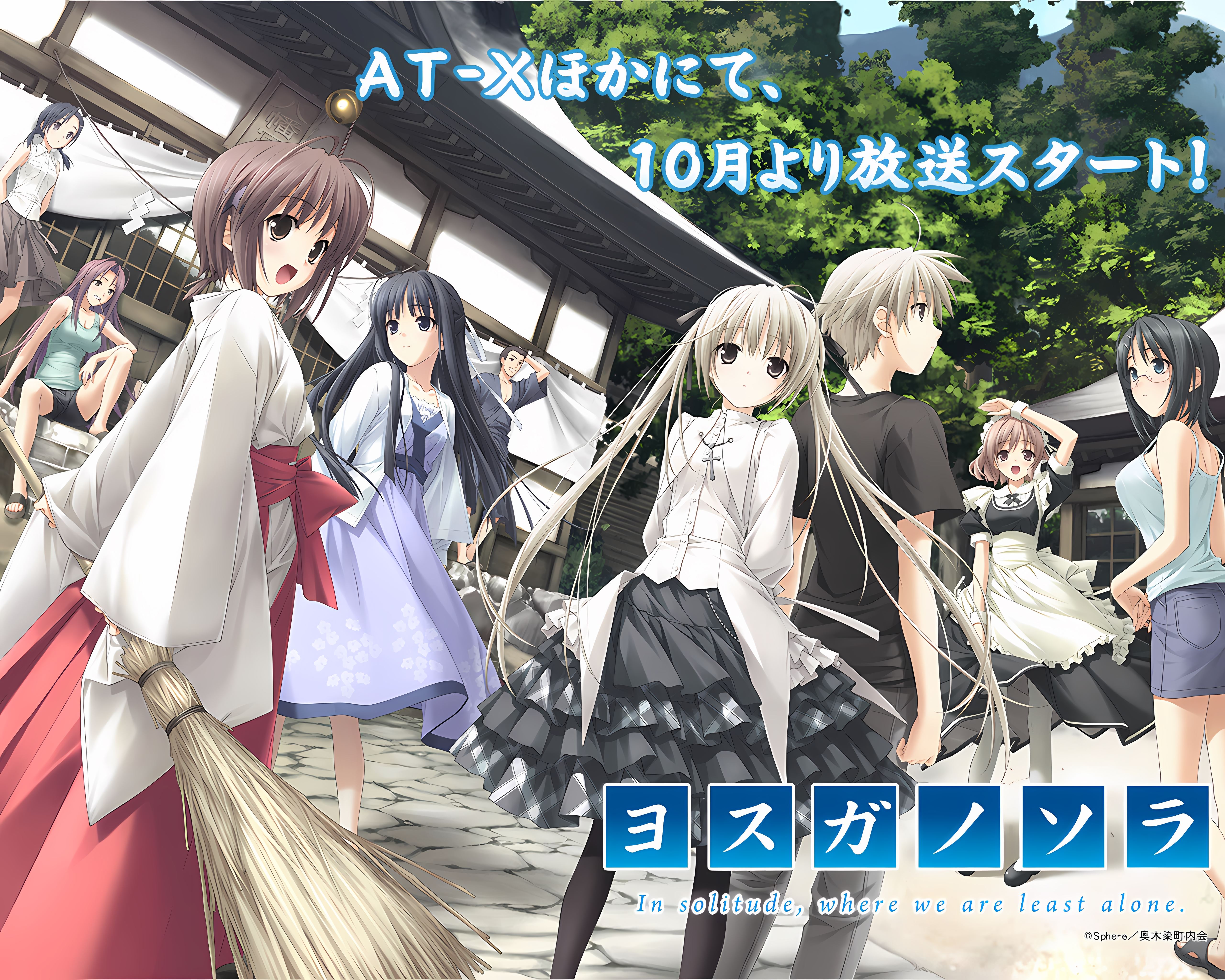
The TV anime began broadcasting on October 4, 2010, successively onAT-X, BS11, and TOKYO MX, concluding on December 20 with a total of 12 episodes. On April 25, 2016, and January 27, 2020, it wasAT-Xrebroadcast.
STAFF
- Original Work:Sphere
- Original Character Design:Takashi Hashimoto、Hiro Suzuhira
- Director:Takeo Takahashi
- Series Composition:Naruhisa Arakawa
- Character Design:Kanetoshi Kamimoto
- Prop Design: Ryouzou Sugiyama
- Art Director: Toshihiro Kohama
- Art Setting: Yoshinori Shiozawa
- Color Design: Hitomi Sano
- Director of Photography: Kazunori Ootakawa
- Editing: Daisuke Hiraki
- Sound Director:Yoshikazu Iwanami
- Music:Manabu Miwa、Bruno Wen-li
- Music Production:STARCHILD RECORD
- Producers: Takahiro Yamanaka, Kawasakiともko
- Planning Cooperation, Production:GANSIS
- Animation Production:feel.
- Produced by: Okukosame Neighborhood Association
CAST
- Haruka Kasugano:Hiro Shimono / Megumi Matsumoto(Childhood)
- Sora Kasugano:Hiroko Taguchi
- Akira Amatsume:Kayo Sakata
- Nao Yorihime:Yuka Inokuchi
- Kazuha Migiwa:Ryoko Ono
- Motoka Nogizaka, Female Student:Tae Okajima
- Kozue Kuranaga:Yukari Minegishi
- Yahiro Ifukube, Shop Clerk:Ryoko Tanaka
- Ryohei Nakazato, Conductor:Takuro Nakakuni
- Tsukimiyama:Daisuke Egawa
- Misao Kasugano:Yasuko Hatori
- Homeroom Teacher, Male Teacher, Teacher:Daisuke Matsuo
- Female Teacher:Chihiro Tagano
- Male Student:Nariya Yoshiya、Mizutani Naoki、Kiriki Jin
- Female students:Momota Kanako、Hayami Akari、Tamai Shiori、Sasaki Ayaka、Momoka Ariyasu、Reni Takagi(The above 6 people are allMomoiro Clovermembers),Nozomi Furuki
- Nao's father:Taku Kimura
- Nao's mother:Rio Natsuki
- Kazuha's father:Katsuhisa Hōki
- Kazuha's mother:Murai Mayo
- Akira's grandfather:Rokuro Naya
- Akira's uncles:Sato Kota
- Akira's aunt:Mika Kanda
- Haruka's father:Atsushi Imaruoka
- Haruka's mother:Kyoko Hikami
- Old lady:Kiyoko Miyazawa
- Attendant:Taira Kikumoto
Episode Titles
| Episode | Subtitle | Chinese Title | Script | Storyboard | Direction | Animation Director | Chief Animation Director | ||
|---|---|---|---|---|---|---|---|---|---|
| Episode 1 | ハルカナキオク | Distant Memories | Naruhisa Arakawa | Takeo Takahashi | Hijiri Sanpei | Ryozo Sugiyama Kuniaki Masuda |
Kanetoshi Kamimoto | ||
| M1 | ダメモトカイナ | Kozue 1 | Had no expectations from the start | Hiromi Ogata | |||||
| Episode 2 | AK2 | アキラハズカシ | Akira, Kazuha 2 | Akira is so embarrassed | Toshiyuki Shimazu | Kota Okuno | Hisashi Kawashima | ||
| M2 | モトカラソコツ | Kozue 2 | Naturally careless | Hiromi Ogata | |||||
| Episode 3 | K3 | ツカズハナレズ | Kazuha 3 | Neither close nor distant | Hiro Akizuki | Takeo Takahashi | Naokatsu Tsuda | Go Suzuki Motoaki Sato |
Ryozo Sugiyama Kuniaki Masuda |
| M3 | イモートカッカ | Kozue 3 | Her Excellency, the Little Sister | Naruhisa Arakawa | Hiromi Ogata | Kanetoshi Kamimoto | |||
| Episode 4 | K4 | ハルカズハート | Kazuha 4 | Haru-Kazu no Kokoro | Hiro Akizuki | Takafumi Fujii | Hiroshi Kosuge Masaru Kawashima | ||
| M4 | イツモトカワレ | Kozue 4 | Not like usual | Naruhisa Arakawa | Hiromi Ogata | ||||
| Episode 5 | A3 | ヤミアキラカニ | Akira 3 | Shadows Appear | Toshiyuki Shimazu | Satoshi Saga | Goro Taki Katsusuke Shimizu | ||
| M5 | モットカチタイ | Kozue 5 | Wanting to win every battle | Takeo Takahashi | Hiromi Ogata | ||||
| Episode 6 | A4 | アキラメナイヨ | Akira 4 | Akira Doesn't Give Up | Nanako Sasaki | Shigeru Ueda | Katsunori Kikuchi | Hiroshi Ino | |
| M6 | モートーカメカ | Kozue 6 | It's already the tenth day | Takeo Takahashi | Hiromi Ogata | Kanetoshi Kamimoto | |||
| Episode 7 | NS2 | ツミナオトメラ | Nao, Sora 2 | Sinful Maidens | Toshiyuki Shimazu | Takafumi Fujii | Kuniaki Masuda Ryozo Sugiyama | ||
| M7 | ミミモトカンデ | Kozue 7 | Bite my ear | Takeo Takahashi | Hiromi Ogata | ||||
| Episode 8 | N3 | ナオクラキソラ | Nao 3 | A Darker Firmament | Masaharu Amiya | Toshiyuki Shimazu | Yusuke Onoda | Haruo Okawara | |
| M8 | ムナモトカモン | Kozue 8 | Chest COME ON | Naruhisa Arakawa | Takeo Takahashi | Hiromi Ogata | |||
| Episode 9 | N4 | ハルカナオモイ | Nao 4 | Distant Memories | Masaharu Amiya | Mitsue Yamazaki | Kenichiro Komaya | Ryozo Sugiyama Shin'ichi Tatsuta |
Takehiro Ishii Kanetoshi Kamimoto |
| M9 | イマモトカイニ | Kozue 9 | Still in the City Today | Naruhisa Arakawa | Takeo Takahashi | Hiromi Ogata | Kanetoshi Kamimoto | ||
| Episode 10 | S3 | トリノソラネハ | Sora 3 | Bird's Sora-naki | Naokatsu Tsuda | Kuniaki Masuda Go Suzuki | |||
| M10 | モトカレイマモ | Kozue 10 | Still an ex-boyfriend | Hiromi Ogata | |||||
| Episode 11 | S4 | ソラメクフタリ | Sora 4 | The ♯♯ Pair | Toshiyuki Shimazu | Satoshi Saga | Katsusuke Shimizu Goro Taki | ||
| M11 | モトカノメモリ | Kozue 11 | Kozue's Memories | Takeo Takahashi | Hijiri Sanpei | Hiromi Ogata | |||
| Episode 12 | S5 | ハルカナソラヘ | Sora 5 | To the Distant Sky | Shigeru Ueda | Shin'ichi Tatsuta Go Suzuki | |||
| M12 | モトカトハルカ | Kozue 12 | Kozue and Haruka | Hiromi Ogata | |||||
BD Cover


Manga Version
The manga was serialized in the magazine "Monthly Comp Ace" from the October 2009 issue to the January 2011 issue, byMikaze Takashiillustrated by.
The story of the manga version takes the original'sSoraroute as the main axis, interspersed withAkira、Kazuha's plot as well asNao's plot to unfold the story.
Detailed explanation of the "Yosuga no Sora" manga plot。
Drama CD
Among the bonuses included with the original Yosuga no Sora game and those provided for purchases on different platforms, as well as the two BD versions, many different drama CDs were included. These drama CDs can be regarded asfan serviceor expansions of the world-building and character settings. Detailed tracks will be listed below.
Game/Anime Guide
| Game Walkthrough |
|---|
|
If it's unclear, you can click the image to view the full size Unofficial recommended completion order:Nao --> Akira --> Kazuha --> Motoka --> Sora Since Sora's route is the main route, it should be saved for last. Otherwise, playing other routes after Sora's will feel like being "spoiled." However, since you're seeing this, it means you've already cheated, so just play however you like. |

| Anime Watching Guide (No Spoilers) |
|---|
|
If it's unclear, you can click the image to view the full size The anime version uses a parallel world narrative style, equivalent to a player choosing different options to enter different routes in the game. The route can be determined by the episode numbers in the titles. |

Main Game and Merchandise Release Information
As of 2022, Yosuga no Sora has released a total of 3 game versions and two Blu-ray versions; excluding the OST in the two Blu-ray boxesOriginal Soundtrackduplicate content, Yosuga no Sora has released a total of 15 CDs; including those already scheduled for production but not yet released, a total of 16 figures and various merchandise such as wall scrolls, body pillows, and telephone cards have been released.I won't count the wall scrolls and body pillows, as they wouldn't pass review anyway.。
Game Release Status
The Yosuga no Sora game has been released in three versions, including the First Press Edition released on December 5, 2008, the Standard Edition released on October 29, 2010, and the Digital Edition released later on June 5, 2015. The core content of the three is the same, but the game engines used and the included bonuses differ.

Specifically, the old version uses the older ONScripter engine, while the new version uses the Kirikiroid engine and features certain changes to the game UI, switching to the same UI system as later CUFFS titles, which is much more user-friendly. For example, the First Press Edition only has sixty save slots, while later versions have a full nine hundred. Regarding mobile ports, the most common ones are Chinese fan translations based on the early ONS version with some UI features stripped; although there are ports of the new KiriKiri version, currently only the raw version exists.Playing the First Press Edition on mobile via ONS, with only twenty save slots for such a long story—can you feel the pain?
Of course, there is also the 2009 FanDisk, commonly known as Haruka no Sora. Haruka no Sora only has a First Press Edition and a later Digital Edition.
-
 Yosuga no Sora First Press Edition Cover
 -
 Yosuga no Sora Standard Edition Cover
 -
 Haruka no Sora First Press Edition Cover


Anime Release Status
The anime Blu-ray Box was also released in two official versions: the four-volume Limited Production Edition released sequentially by heroine alongside the 2011 TV broadcast, and the "First Press Limited Edition" released in 2016, which, despite its name, was actually released later.
The 2016 version is still occasionally in stock on Amazon Japan, and used copies of both versions are frequently sold on websites such as Amazon Japan, Yahoo! Auctions, and Mercari. There is no difference between the two in terms of the main anime content or the included OST; the main difference in content lies in the bonus drama CDs. Additionally, the Limited Production Edition included a plushie of Sora in a black dress.
Furthermore, a Regular Edition of the Sora route (without the plushie and other bonuses) was released for the 2011 version, and an official budget Blu-ray disc was also released in North America.
-
 Limited Production Edition Blu-ray Box, some first-press bonuses
 -
 First Press Limited Edition Blu-ray Box
 -
 Sora Route Regular Edition cover
 -
 North American budget Blu-ray cover


Manga distribution

Following the conclusion of its serialization, the manga was released in two tankobon volumes on May 21, 2010, and December 21, 2010, respectively.
On September 22 of the following year, Kadokawa Taiwan released the official Traditional Chinese version in Taiwan.
Both language versions were later reprinted; the content is identical, with only the obi (book bands) being different.
Additionally, there are some scatteredMikaze Takashipostcard bonuses featuring celebratory illustrations.
| Volumes | Cover | Japanese version Kadokawa Shoten |
Traditional Chinese Edition Kadokawa Taiwan | ||
|---|---|---|---|---|---|
| Release Date | ISBN | Release Date | ISBN | ||
| 1 | 
|
2010May 21 | ISBN 978-4-04-715428-5 | 2011September 24 | ISBN 978-986-287-312-0 |
| 2 | 
|
December 21, 2010 | ISBN 978-4-04-715586-2 | ISBN 978-986-287-366-3 | |
Music Releases
Excluding duplicate content of the anime soundtrack (OST) in the two versions of the Blu-ray boxes, as well as duplicates from the four different limited edition anime ED discs, a total of fifteen CDs and one Hi-Res high-quality lossless album have been released for the Yosuga no Sora anime and game. They are as follows (in chronological order):[3]:
- C74 Limited Galgame Theme Song Album Title:PCゲーム ヨスガノソラ ヨスガノソラ Maxi-single オープニング「道の先、空の向こう」
Release Date: 2008-08-15 (C74)

Artist: Rita
Composer: Manabu Miwa
Lyricist: Ayaka
Tracklist:
1. Game Opening Theme 道の先、空の向こう(The Road Ahead, the Sky's End)
2. Game Ending Theme 夜明けのプリズム(Yoake no Prism)
3.道の先、空の向こう ~off vocal~[4]
4.夜明けのプリズム ~off vocal~
Lyrics, Composition:Ayaka, Manack(Manabu Miwa), Vocals:Rita
- 2008 Galgame First Press Limited Edition Bundled Bonus (included in the first press Galgame box):ヨスガノソラ Game Image CD 「君、繋ぐ空。」
Release Date: 2008-12-05

Tracklist:
- Kimi, Tsunagu Sora.
- Symphonic Poem Yosuga no Sora
- Kimi, Tsunagu Sora. (instrumental)
Artist: Rita
Composer: Toshinori Orikura
Lyricist: Kotsukimiya
- Game First Press Limited Edition Messe Purchase Bonus Drama CD: Original Drama 「叉依姫神社祭り」
Released simultaneously with the galgame.

List:
- Sayohime Shrine Festival's Beginning
- The Festival is a Free-for-all
- Break Time Before the Kagura
- Invitation to Miko-Miko
- The Price of Misdeeds
- The Festival is Just Getting Started
- Game First Press Limited Edition Sofmap Bonus Voice Drama:「秘密のリゾート遊び」

Album Cover

Released simultaneously with the galgame.
List:
- Everyone Gathered
- Mountain Climbing in Swimsuits
- Now, Let's Play to Our Heart's Content!
- A High-Maintenance Guardian
- Checking the Tan Lines
- More Fun Times to Come
- 2009 Galgame OST:ヨスガノソラ Game OST「ヨスガノソラ SOUND TRACK CD」

Album Cover

Release Date: 2009-02-27
Artist: Rita
Composer: Manack(Manabu Miwa)
Lyricist: Ayaka
Tracklist:
- "The End of the Road, Beyond the Sky" (Short Ver)
- In That Place Where a Gentle Breeze Blows
- Even Though It's Not a Lullaby
- Longing for a Slow Life
- The Vast Sky and Paper Planes
- After School Spent on a Lap Pillow
- Honesty, Clumsiness, and Stubbornness
- The Way Home at Twilight
- Cold Tears Streaming Down My Cheeks
- Pitch-black Intentions
- Between Feelings
- Mufu~
- Alright, go for it!
- Having fun now is winning!
- Lonely Night
- The Precious Heart That Won't Fade
- What I've Been Seeking
- Drops of Stars
- A Step Toward the Future
- Opening a New Land
- "Prism of Dawn" (Short Ver)
- Haruka na Sora Pre-order Bonus:ソイネノソラ ~春日野穹ピロートークCD~Also known as the most classic version of the "Sleeping Together" CD

Album Cover

Release Date: 2009-09-01 (Based on the start date of pre-order sales)
- Haruka na Sora First Press Bundled Bonus Character Songs (Included inside the first press edition box):キャラクターソングCD

Album Cover

Release Date: 2009-09-25
Tracklist:
- フタリ(Theme Song / Sora Character Song)
- Love Clover(Motoka Character Song, voiced by Motoka's CV)
- アリガト(Kazuha Character Song, voiced by Kazuha's CV)
- ラッパ寿司のテーマ(Akira Character Song, voiced by Akira's CV)
- フタリ (春日野穹ver)(Character Song sung by Sora herself)
- フタリ (Instrumental)
- Love Clover (Instrumental)
- アリガト (Instrumental)
- ラッパ寿司のテーマ (Instrumental)
The above is game music, the following is anime music
- Anime OP Opening Theme:比翼の羽根

Album Cover

Release Date: 2010-10-27
Artist: eufonius
Composer: Hajime Kikuchi
Lyricist: riya
Tracklist:
- 比翼の羽根(TV order Episode 1 - Episode 11 OP)
- パトリ
- 比翼の羽根 Off Vocal Ver.
- パトリ Off Vocal Ver.
- anime adaptation.番組挿入歌 ED between the main episode and the Kozue mini-theater:ツナグキズナ (Connected Bonds)

Album Cover

Release Date: 2010-10-27 Artist: Team.Nekokan [Neko] feat.Junka Amaoto
Composer: nyanyannya
Lyricist: nyanyannya、Junka Amaoto
Tracklist:
- Tsunagu Kizuna
- Misora ni Tsuzuku Hikari
- Tsunagu Kizuna (off vocal ver.)
- Misora ni Tsuzuku Hikari (off vocal ver.)
- Airman ga Taosenai (Junka Amaoto ver.) / BONUS TRACK
- Anime ED Female chorus after the mini-theater:ピンキージョーンズ
This CD has four versions: a regular edition and three limited first-press editions (A, B, and C), with different covers but identical content.
-
 Regular Edition Cover
 -
 Limited First-Press Edition A Cover
 -
 Limited First-Press Edition B Cover
 -
 Limited First-Press Edition C Cover


Artist: Momoiro Clover, Momoiro Clover Z
Composer: Kenichi Maeyamada、NARASAKI
Lyricist: Kenichi Maeyamada、Naotama Murano
Arrangement: NARASAKI、Kenichi Maeyamada
Tracklist:
- Pinky Jones / TV Anime "Yosuga no Sora" ED Theme
- Coco Natsu / Movie "Shirome" Theme Song
- Kimi to Sekai / Game Theme Song
- Pinky Jones (off vocal ver.)
- Coco Natsu (off vocal ver.)
- Kimi to Sekai (off vocal ver.)
The following are the four CDs included with the Limited Edition Blu-ray Box, released sequentially according to the TV broadcast order of the four heroines' routes. These four albums generally use the same artwork as the BD covers.
- Limited Edition Blu-ray Box Kazuha Route Bonus:ヨスガノソラ 渚一葉:オリジナルサウンドトラック -Arrange- (Contains variations of the original game OST used in the anime)
Release Date: 2010-12-22
This album, like the game OST, was handled by Manack(Manabu Miwa).
Tracklist:
|
|
- Limited Edition Blu-ray Box Akira Route Special Drama CD:ヨスガノソラ 天女目瑛:添い寝CD Kazuha and Akira's Co-sleeping CD
Release Date: 2011-01-26
- Limited Edition Blu-ray Box Nao Route Special Feature:ヨスガノソラ 依媛奈緒:オリジナルサウンドトラック -New- (Includes the original anime OST and anime character image songs for the four heroines[5])[6]

This album was handled by Bruno Wen-li, which is actually the artistJun Ichikawa's pseudonym, as confirmed by the artist himself on Twitter.
[7]
Tracklist:
- ヨスガノソラ メインテーマ -遠い空へ-
- ヨスガノソラ メインテーマ -祈り-
- 笑顔の行方
- 二人の距離
- ヨスガノソラ メインテーマ -記憶-
- Suspended
- ヨスガノソラ メインテーマ -願い-
- 追憶ハート
- その日の事
- Before it's too late
- もう10日目か
- 折れない心
- リセットボタン
- ハルカノココロ
- Rain like tears
- 戸惑いの中
- Old Memory(Anime Sora Character Song)
- 君の笑う声(Anime Akira Character Song)
- So Sweet Sorrow(Anime Nao Character Song)
- Deep Inside Region(Anime Kazuha Character Song)
- 言い出せなくて
- June Song
- 喪失の予感
- 暗闇の向こう
Release Date: 2011-02-23
This album includes most of Yosuga no Sora's most famous tracks, 記憶、遠い空へ variations of main themes, the celesta in Old Memory, the violin in Deep Inside Region, the harp in So Sweet Sorrow, and the piano in Kimi no Warau Koe, which are all very impressive.
- Limited Edition Blu-ray Box Sora Route Bonus Drama:ヨスガノソラ 春日野穹:添い寝CD Nao and Sora's Sleeping Together CD
Release Date: 2011-03-23
- New bonus included with the 2016 "First Press Limited Edition" Blu-ray Box:ヨスガノソラ シチュエーションドラマCD「イチャイチャノソラ」Another version of the Sleeping Together CD for the four heroines

CD Cover

Release Date: 2016-09-21
Tracklist:
- Kazuha Migiwa Arc "Neoki no Kazuha"
- Akira Amatsume Arc "Akira no Munemomi"
- Nao Yorihime Arc "Nao no Kanbyou"
- Sora Kasugano Arc "Ofuro no Sora"
Note: This Blu-ray box also includes the 2011 OST content; since there are no changes, it will not be listed separately.
- Hi-Res high-resolution version of the anime music, including the OP,番組挿入歌
You can tell who the real ED is now, right?and the content of the two OSTs, with a sample rate and bit depth of 48kHz/24bit.
Album Cover

Release Date: 2016-09-21
This album is a digital version, and you can conveniently go toMORAore-onkyoto buy the official version.
Tracklist:
|
|
Other Merchandise
The Yosuga no Sora IP has very strong vitality—merchandise has been released continuously without interruption, with new products coming out every year.
Bonus Artbook:
- ヨスガノソラVisual Art Collection, the pre-order bonus booklet for the first press edition of the Yosuga no Sora game, including a few official illustrations and celebratory illustrations by other artists.

Physical photo, the image is the same as the game cover. - Participating artists:橋本タカシ、☆画野朗、兼清みわ、源之助、フミオ、ちこたむ、鈴平ひろ、七尾奈留、九尾、KEG、小沢悠、狐印、鶏野郎、緋賀ゆかり、植田亮、カントク

Setting guides have been released for both the visual novel and the anime:
- ヨスガノソラ ビジュアルファンブック.(VISUAL FANBOOK, often abbreviated as VFB) The setting guide for the visual novel. The content mainly consists of character and scene art settings, as well as illustrations showcasing merchandise. It consists of one color volume and one line art volume, each over a hundred pages long and very substantial.
- ヨスガノソラ OFFICAL CHARACTER BOOK.The setting guide for the anime, which contains less content compared to the game's setting guide.It's even less than what's in the booklets included with the Blu-rays., mainly consisting of official promotional illustrations (unlike the game, the celebratory illustrations for the anime are all drawn by official artists), character art settings, plot introductions, and interviews with the director.
Additionally, both versions of the setting guides have related bonus merchandise. The bonus for the visual novel setting guide is a transparent desk mat and paper line art of the four heroines: Sora, Akira, Kazuha, and Motoka (for unknown reasons, bonuses were not produced for the other heroines). The anime setting guide features a relatively rare lottery-draw book card.
-
 Visual novel setting guide cover - Color volume
 -
 Visual novel setting guide cover - Line art volume
 -
 Galgame setting guide physical copy/bonus items
 -
 Group photo of the four heroines' bonus items
 -
 Anime setting guide cover
 -
 Anime setting guide physical copy
 -
 Anime setting guide book card bonus


Others: Other related merchandise is vast as the ocean; basically, one figure is released every year according to the pattern[8], one or two wall scrolls, and a dakimakura every year or two; in earlier years of Comiket (CM), the company Sphere would often sell items on-site. Besides these, there are various store bonuses given when purchasing from different platforms at the time of release, mainly consisting of various towels, dakimakura, bedsheets, and other bedding, along with countless telephone cards.
Yosuga-ologist Research

- The Kasugano family's initial residence was Tokyo. In the Sora route of "Yosuga no Sora," Haruka has a monologue while watching TV: "Sometimes, images of Tokyo are shown on TV... seeing them makes me feel a bit nostalgic." This is the basis for the inference. In Kozue's route in the game, it is also stated that Haruka came from Tokyo.
- Kasugano Sora and Haruka's mother might be Finnish. Most characters in this work have hair colors close to black, but only the Kasugano siblings and their mother have light-colored hair. In the anime version, when Sora looks at the family photo, it is clearly visible that the father has black Asian hair, while the mother's hair is as white as plaster. In terms of height, Haruka and Sora's mother is even about as tall as the father. The height and hair color lead to speculation that the mother has Caucasian blood; as for why Finland is mentioned[9], see below.
- The destination for Haruka and Sora's trip (settling down in the anime) at the end is Finland. In "Haruka na Sora," Haruka received two plane tickets to Helsinki, Finland, along with a letter. Additionally, it is mentioned in "Haruka na Sora" that their parents had processed Haruka and Sora's Finnish passports long ago. When Haruka and Sora are traveling, they are at a very large Market Square, which corresponds to the famous Market Square attraction in Finland. The ring purchased by Haruka and Sora is engraved with "Siunaus," which means "blessing" in Finnish.
- When the anime first aired, some viewers believed the ending implied that "Haruka and Sora actually drowned in the lake." However, the arguments for the "drowning theory" are based only on groundless speculation, and there is no substantial evidence to suggest that this was an "alternate ending" intentionally designed by the production team.
| Reasons for the "drowning theory" |
|---|
|
| Rebuttals to the "Drowning Theory" |
|---|
|
Even though the anime made many adaptations to the original game's plot, meaning the duo's return in the original game cannot be used to disprove this view, there is still plenty of evidence that drowning does not align with the anime's plot.  Translation: "Haruka, who once wanted to disappear from this world together with Sora. (This also echoes Haruka's monologue when he was near unconsciousness underwater.) After such an experience, he perhaps decided on his future life because of it. That is, to live only to protect what is important to him." Original commentary on the plot of the train scene at the end: "お互いがいれば、それだけでいいーーこのふたりの夢は叶ったのだろうか。それども、また同じ苦しみを繰り返ことになるのが。それは誰にもわからない……。」 Translation: "The two together, that's all that matters. The dreams of these two have likely been realized. Or perhaps, they have fallen back into the same cycle of painful reincarnation. No one can know for sure." The expression in these two passages is clear: the siblings nearly drowned, and after this experience, Haruka solidified his resolve to protect his beloved Sora forever. The latter passage also discusses whether "this choice they made to leave home and depend on each other (which differs from the original game) is a Happy End where they stay together forever, or a Bad End where they endure an even harder life and the judgment of those around them (which also echoes the class representative in the final episode of the animethis plot device character who plays the 'bad cop' role 's opposition)." Another strong piece of evidence is the official intention to produce a Haruka na Sora OVA later on. This at least shows that from the official perspective, the "drowning" adaptation does not exist, and just like in the original game, they returned normally and entered the plot of Haruka na Sora. |
Rumors regarding the "President" and "sequel production"
In 2020, Mr. katahito, who was responsible for the production of Yosuga no Sora and the subsequent coordination of the anime adaptation at the game company sphere (it is also incorrect that domestic netizens often call him "President"; he is not the president of sphere)[10]once clearly expressed the intention to produce a sequel, a Haruka na Sora OVA[11]。
However, there has been almost no related news since then. After Mr. katahito joined Bilibili[12]he has hardly mentioned it again, only frequently sharing anecdotes from the production of Yosuga no Sora and information about newly released merchandise.
Currently, the production of a sequel should perhaps be considered a proposal that is intended and possible, but has low feasibility considering realistic issues such as budget and market.[13]Perhaps there will beZack Snyder's Justice Leaguea miracle like that
See also

- Sora-chan
- Siscon
- It's great to have a capable sister
- A blood sister is not as good as a foster sister
- Wishing my sister were Sora
Notes
- ↑ 縁(えん)とは? 意味や使い方 - コトバンク
Original text:よす‐が【▽縁/▽因/▽便】身や心のよりどころとすること。頼りとすること。また、身寄り。血縁者。よるべ。「知人を―に上京する」「身を寄せる―もない」 - ↑ The anime adopts a multi-route storytelling method, where some episodes contain common plot points for multiple routes, while the remaining episodes exist as parallel worlds relative to each other. If you watch every route completely from start to finish, there are 17 episodes in total.
- ↑ NetEase Cloud Music resources are incomplete. For more information and resource downloads, please support the official release or visitbangumiSearchHowever, the information compiled in this entry seems to be more comprehensive than Bangumi's.Or search for the compilation thread in the Yosuga no Sora Bar.
- ↑ "off vocal" or "instrumental" both refer to pure accompaniment versions without vocals; the same applies below.
- ↑ The character songs here refer to the four tracks used as BGM in the Blu-ray omnibus editions for the four heroines.
- ↑ This album on NetEase Cloud Music was uploaded by an individual and uses the wrong image; it should be the cover of the third Blu-ray volume.
- ↑ It was accidentally discovered by a netizen in 2020 while searching for Jun Ichikawa.Origin
- ↑ For information regarding figures, please visithpoi
- ↑ In reality, Finns belong to a branch of the Uralic people, sharing the same origin as Hungarians, Khanty people, etc., and are significantly distinct from the ethnic groups of other Nordic countries. However, during the long years of Swedish occupation of Finland, intermarriage between the two ethnic groups caused Finnish physical characteristics to lean towards those of Nordic people.
- ↑ katahito's personal Twitter
- ↑ One of the tweets, further ones can no longer be traced.
- ↑ Bilibili official account
- ↑ This tweetThe general idea is "considering whether a YouTube debut would secure more crowdfunding budget, it can be inferred that the official side will likely not provide sufficient funds.
External Links

- (Japanese)Game official website
- (Japanese)Anime official website
- Yosuga no Sora on Steam